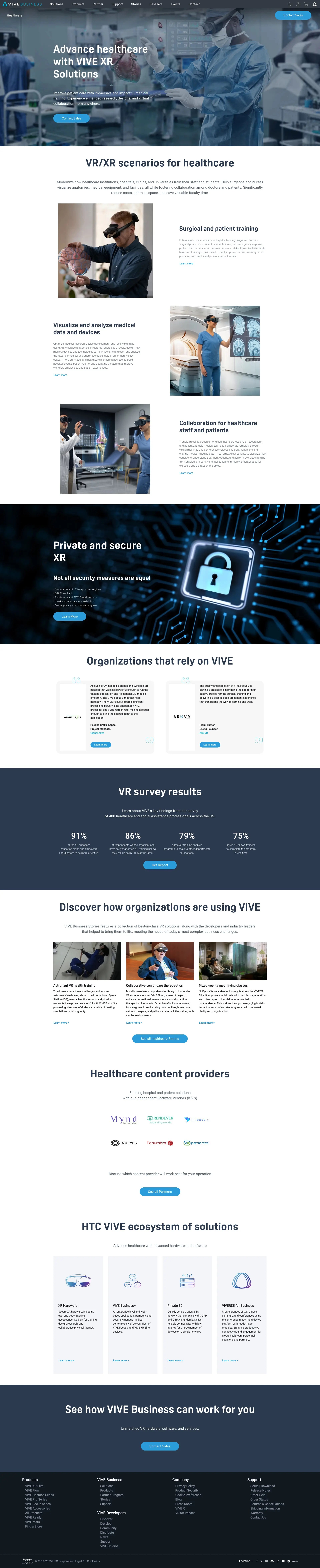
Advance healthcare with VIVE XR Solutions
Role Web and Digital Designer, HTC VIVE (in-house)
Year 2022 to 2024, pages still live 2026
Client HTC VIVE, EMEA marketing
Team 2 designers, 2 developers, 2 marketing managers
I owned The page template: module set, page architecture, visual system, responsive behaviour, and the front-end build in HTML, CSS and JS
I did not own copy, photography, the CMS build
Introduction
HTC VIVE sells enterprise VR into industries that have almost nothing in common: hospitals, factories, universities, defence. Each one needed a landing page, each one had a different objection, and the EMEA marketing team needed to launch the next vertical without waiting on a designer.
So I did not design ten pages. I designed one template and the eight modules it is built from, and the marketing team assembled the rest.
The system
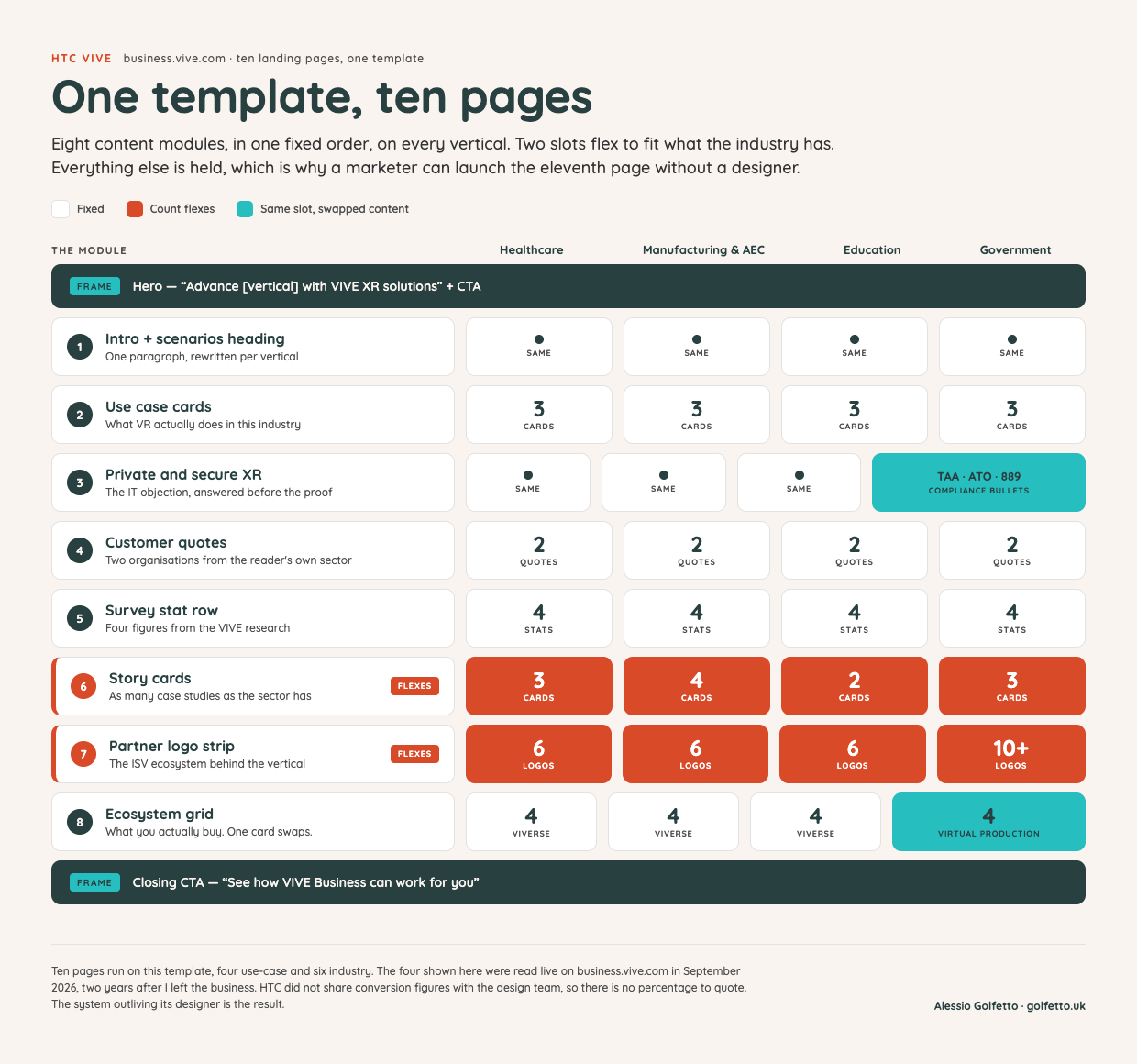
Eight content modules, in one fixed order, on every vertical.
The order is the argument. What VR does in your industry, then proof it is safe to put on your network, then two people in your sector saying it worked, then the survey numbers, then the organisations already doing it, then what you actually buy, then one way to start a conversation.
Holding that order constant across every vertical is the whole point. A marketer launching the eleventh page is not making layout decisions, they are filling eight slots. Two of those slots flex: the story cards take two to four depending on how many case studies that industry has, and the partner logo strip takes six to eleven. Everything else is fixed, so no page can drift.
The security module sits fourth on every page, high and unmissable, because the objection is the same in every industry and it is never about the headset. It is about whether the thing touches your network.
What I decided
- One template, not ten designs. Ten bespoke pages would have looked better on day one and been unmaintainable by month three. The template is why ten pages are still live two years after I left.
- A fixed module order rather than a per-industry layout. It costs some expressiveness on each page and buys the marketing team the ability to ship a vertical without a designer. On a team of 6 that was the right trade.
- Only two slots allowed to vary. Story cards and partner logos flex because supply of both genuinely differs by industry. Letting anything else vary would have turned a template back into ten designs within a year.
- The security block placed above the social proof, not below it. In enterprise VR the blocker is IT, not the end user. Moving that objection up the page was the one structural decision I would defend hardest.
- Lead capture segmented by job function and industry, so enquiries arrived pre-sorted for the sales team rather than as an undifferentiated pile.
Results & Impact
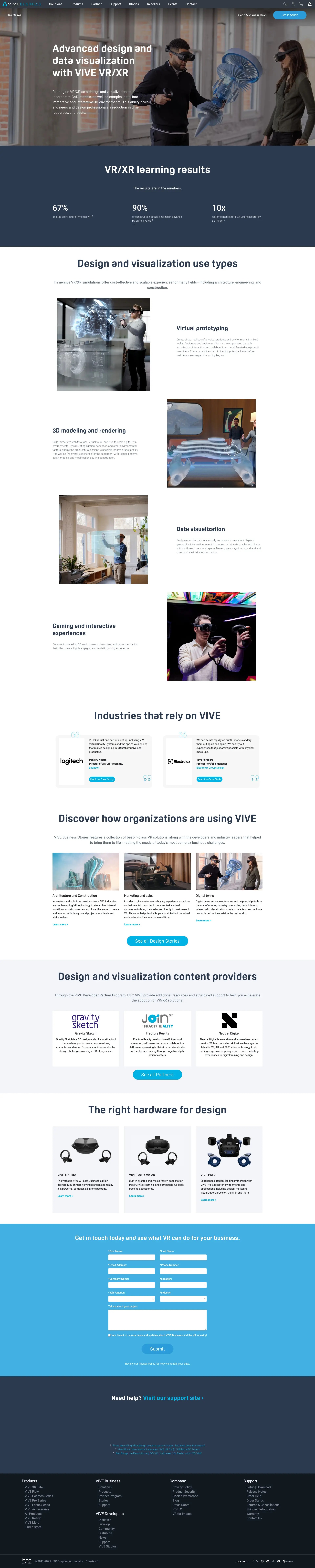
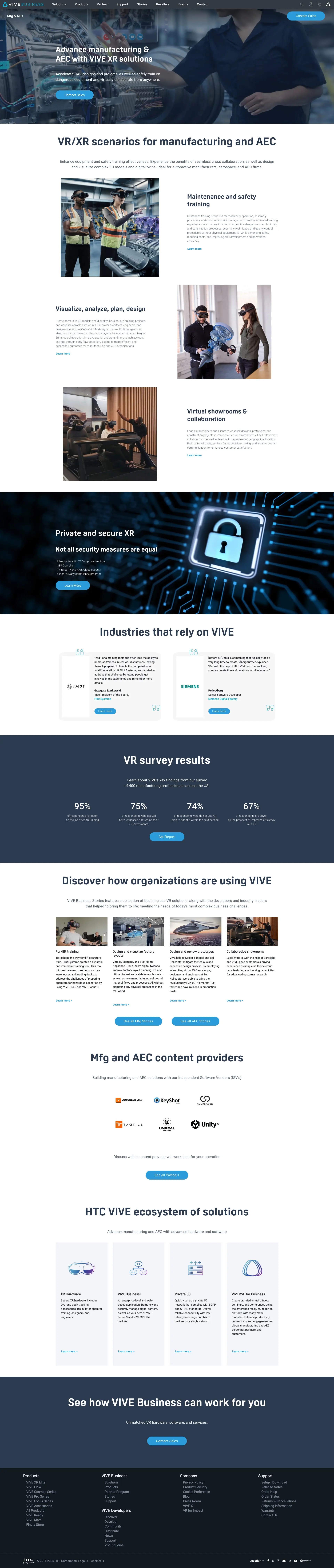
The system is still running. Ten pages built on it are live on business.vive.com today, four use-case pages and six industry pages, nearly two years after I left the business and up to four years after the first ones went out. Marketing work rarely survives that long. These did, because they were built as a template rather than as ten separate designs.
Each page carries the same eight content modules in the same order, and every one ends in the same CTA, with an enquiry form behind it that segments by job function and industry. That meant the marketing team could launch a new vertical without a designer or a developer, which was the point.
HTC did not share conversion figures with the design team, so I can’t quote a percentage. What I can point to is a system that outlived the people who built it and is still generating enquiries.
I build landing pages that a marketing team can still run after the designer leaves. If that is the problem you have, I am open to permanent and freelance roles. alessio@golfetto.uk